
Dala Resources LLC intends to complete the assessment of lithium and other solid mineral reserves at the Kene and Bayash sites in the Ulan district of the East Kazakhstan region, Farkhat Ergaliyev, CEO and sole owner of Dala Resources LLC, told Qazba.kz.
“We are currently in the assessment phase. We declare that, yes, we have made a discovery and are currently in the process of assessing it. We should complete the assessment of lithium and other solid mineral reserves by September [2026 – author’s note],” he told Qazba.kz in an interview on the sidelines of the MINEX Kazakhstan 2026 forum.
The reserves will be approved in accordance with the KAZRC National Reserves Reporting Code (CRIRSCO). According to studies conducted back in Soviet times, the lithium grade at Kene and Bayash was 2.8%. Ergaliev confirmed the presence of such a grade in individual blocks of the sites.
He noted that during the Soviet era, exploration was conducted for tantalum, but lithium wasn’t of particular interest to geologists at the time.
“They (Kene and Bayash – author’s note) were explored during Soviet times, but for a different [metal – author’s note] – for tantalum. Lithium wasn’t of interest to anyone at the time. Everyone was looking at tantalum with the prospect of discovering it. The Belogorsk Mining and Processing Plant, which is located right there, was a unique facility. It was vertically integrated with a large number of mines and deposits: what’s now much talked about is Bakennoye (a rare metal deposit – author’s note), Yubileynoye, and Ognevskoye. They were all developing and developing all of these for tantalum. At the same time, lithium was noted to be present. Of course, not lithium, but spodumene — lithium in the form of spodumene. It was noted that it existed. But it hadn’t been fully explored,” he said.
However, because tantalum was found there in small quantities, the sites were deemed uninteresting. Now, they have become popular again due to the growing global popularity of lithium.
Ergaliyev noted that he comes from a family of geologist, and that his father and friends explored the territory of eastern Kazakhstan. In fact, these are roughly the same areas previously explored by Soviet geologists.
“Our expectations are very high…. There are certain difficulties here with access to all the sites, which we would like to expand further. That is, in the Kene section, we’ve already received a third license. We’ve expanded. We see that the ore field is more widespread, broader. And we need to look further. We’re currently completing the assessment of the central part of the sites. We still need to look at the flanks, the periphery to fully cover everything. But this is completely new. That is, in Soviet times, they didn’t pay attention to this,” he said.
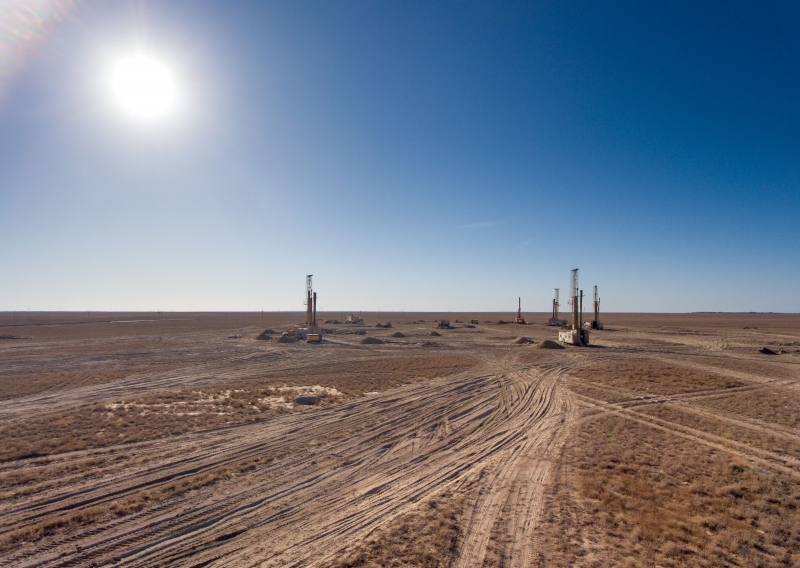
The company drilled, dug trenches, took samples and analyzed the obtained materials in Ireland, Germany and Canada. In addition to lithium, the presence of rubidium and cesium is being studied.
According to the company’s head, companies from China, Japan, South Korea, Germany, and other countries could become future partners. Ergaliyev previously collaborated with Japan on other projects.
The mining and processing of solid minerals could begin in 2030-2031. Specifically, the possibility of processing at the Ulba Metallurgical Plant, a subsidiary of the national company Kazatomprom, is being considered.
“This is all possible. The Ulba Metallurgical Plant, which was previously part of the Belogorsk Mining and Processing Plant, is there for this purpose. So, it wasn’t a Kazatomprom enterprise from the start. It was a Soviet enterprise… So, the capacity there is still there,” he said.
Primary ore processing will take place at the deposit.
“We need to register the reserves (lithium and solid minerals – author’s note). After that, the project development process begins, which means it needs to be built on-site… Primary processing still needs to be on-site, which means a mine needs to be built. The infrastructure needs to be established. Many related issues need to be resolved,” the company’s head said.
According to him, the local population is positive about the project, as it will create jobs. Ergaliyev does not specify the possible investment required to begin lithium mining, saying only that project documentation will begin to be developed after the reserves are registered. A detailed search for project partners will then start.
“The main question for us is not technical, but financial. Will we be able to attract financing when needed?” he said.
Currently, the company is discussing possible cooperation with large Chinese companies, as China is the global leader in the lithium market. Ergaliyev noted that in the 1950s, Kazakhstani geologists and other specialists taught their Chinese colleagues how to work with tantalum and other metals.
“But we stopped. And they went further. Now we’ll learn from them,” he said.
Besides China, the United States, Japan, South Korea and Germany may also show interest in the project. However, he doubts the company will choose an investor who offers the best project financing terms or finished product prices. Ergaliyev notes that there are many lithium projects worldwide with which they must compete for funding.
“We certainly see interest. But, strictly speaking, we need reliable investors and reliable partners. We’re looking for a partner not just as an investor, but preferably one with experience in this specific field. Because, unfortunately, we’ve long since lost many of our advantages, and we need to see what they’re doing and how they’re doing it,” he said.
The company received several exploration licenses in 2019 and later extended them until 2030. There are also plans to expand the area of operations.
“We’re still obtaining, or at least trying to obtain (licenses – author’s note). It’s not as simple a process as they say, in reality. We’ll expand,” he said.
According to him, the Kazakh Subsoil Code overlooks this issue with junior companies that have acquired several blocks and are unable to quickly expand their territories.
“When you acquire a territory, you can’t know what’s underground… We now see that the deposits we’re interested in extend a little further. And, of course, from the standpoint of building a comprehensive development, we need to gain access to the entire deposit. We can’t just work on a portion of it,” he said.
Ergaliyev believes that when acquiring exploration blocks, certain buffer zones should be left to prevent other companies from entering adjacent territories. He notes that this practice is common in Kazakhstan.
The Bayash block is located in the Ulan District of the East Kazakhstan Region, 25 km southeast of Ust-Kamenogorsk, within the Karagoin-Saryozek rare-metal pegmatite zone, which specializes in lithium. In 2022, the company tested three historical trenches, which yielded lithium oxide grades of 0.68% and 0.63%, respectively. Another trench also yielded tin concentrations of up to 1,192 grams per ton.
The Kene site is located 37 km southeast of Ust-Kamenogorsk. Soviet geologists believed it held good prospects for discovering large lithium reserves with associated tantalum and tin mineralization. Historical documents indicated that the average lithium oxide grade in the central zone of the site was 1.3%, with maximum values reaching 2.8%. In 2022, the company drilled a well and found that the average lithium oxide grade was 0.35%, with a maximum grade of 2.16%.