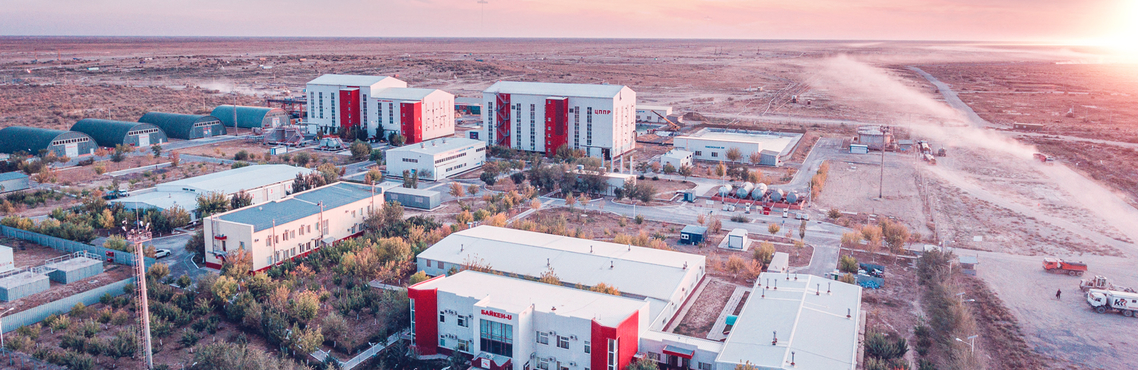

Canadian mining company First Quantum Minerals (FQM) is continuing its copper exploration in Kazakhstan for the third year. James Banyard, Geology Manager for its Kazakhstani division, FQM Exploration Kazakhstan, spoke about this on the sidelines of the 16th Mining and Exploration Forum MINEX Kazakhstan 2026 in Astana.
“Overall, I think the prospects in Kazakhstan remain very promising. Thanks to the reforms of the last few years, the volume of foreign investment attracted and competition are certainly growing. But we still believe that there are areas where we, as First Quantum, have, so to speak, a competitive advantage, and leveraging our experience gained in Zambia certainly gives us a different perspective on the situation in the Chu-Sarysu Basin than other companies,” the geologist shared his opinion in an interview with qazba.kz.
According to him, the company has now begun to rely more on obtaining its own licenses.
“Over the past couple of years, our company has been building a project portfolio. We began primarily with joint projects with Pallas Resources. We are now entering a phase where First Quantum holds a large number of its own licenses, 100% of which are owned by the company. So, we own five licenses totaling approximately 700 square kilometers, as well as one license issued through a joint venture with Pallas, covering approximately 450 square kilometers,” said James Banyard.
With such a small exploration portfolio, FQM intends to focus on identifying and testing target areas. Last summer, the company conducted diamond drilling at three locations in the Chu-Sarysu basin, and while the results were not favorable for economic mineralization, lessons were learned.
“We’ve learned a tremendous amount about the basin, and this is truly the first time we, as a foreign company, have seen these rocks. It’s crucial that we learn as quickly as possible, and drilling is the fastest way to learn.” “That’s why we’ve prioritized this, and as we move into 2026, we intend to conduct more targeting and drilling to test our entire portfolio,” the specialist explained.
He clarified in the conversation that the company holds two licenses near the old Kounrad mine north of the city of Balkhash, while the remaining subsoil use rights are concentrated around Zhezkazgan.
In the conversation, a qazba.kz correspondent also inquired whether the company had encountered any uranium occurrences in the Chu-Sarysu basin. If so, then, according to the law, Kazatomprom could also claim rights to this area.
“We’re looking for uranium, but we haven’t found anything yet. And the uranium deposits are located further south in the basin, far from our exploration sites. Therefore, we assume we won’t find uranium in the northern part of the basin, where we are now. So, there’s no uranium,” James Banyard noted.
According to the geologist, the total exploration investment budget in Kazakhstan this year could reach $4-5 million, including the involvement of international specialists. This makes the country FQM’s second-largest exploration spender, after Zambia.
He also said that his company is currently selling the Las Cruces copper project in Spain. According to media reports, the project previously had a very high grade of 5-6%; however, after depletion, production switched to a hydrometallurgical method for extracting the remaining tailings, which contain 1% copper, 1% lead, and 2.5% zinc. Further plans called for the construction of a polymetallic metallurgical plant costing over $500 million, which would increase production to 21,000 tons of copper, 50,000 tons of zinc, and 35 tons of silver per year and extend the mine’s life by more than 18 years.
FQM is also selling the Çayeli deposit in Turkey to Gengiz Holding. Therefore, the company wants to focus more on production in Zambia and Latin America, according to its strategy, and Kazakhstan may add more options to mitigate global risks.
“FQM is always assessing the political and operational environment in other Central Asian countries. We know that Mongolia and Uzbekistan have very rich porphyry copper deposits. Therefore, we know there is geological potential there. We are constantly assessing the legal framework and whether we can operate in accordance with our standards and international standards as a publicly traded company. We will continue to evaluate these jurisdictions, but even if we don’t do so immediately, we will continue to monitor what may happen in five to ten years and how the investment climate changes. This is one of the reasons we are in Central Asia: to learn more about the region as a whole,” said James Banyard, responding to a question from qazba.kz.
He also stated that the company, in general, has no particular problems interacting with local communities in the regions where it operates.
“I think the needs of the local population largely coincide with how First Quantum prefers to operate. We don’t use cash payments; we prefer to invest funds comparable in scale to our exploration work. “You can’t build a school when you’re just drilling your first well and don’t know the project’s potential, but you can offer local residents opportunities to work on your projects or purchase their services locally,” the geologist noted.
According to him, the company purchases water, utilities, food, and other goods from Kazakhstani villages where possible. Last year, as part of its corporate social responsibility, it drilled several wells in the village of Aktogay in the Karaganda region to help local residents irrigate previously planted trees, a similar assistance program to the company’s other efforts.
This text is translated from original article in Russian using Google Translate.